
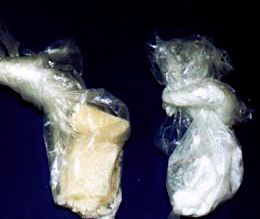
One of the many sore points in the war on drugs has been the sentencing disparities that have tended to put too many minorities behind bars. Civil rights groups have howled for years about the legal unfairness of handing out heavier sentences for possession and sale of crack cocaine than for powdered cocaine. They can rejoice this weekend about getting a measure of closure on a long-standing emotional hot-button: Since crack is more popular in African American and other minority neighborhoods, while powdered cocaine is preferred in the Anglo-American suburbs… you get the picture. Today, the U.S. Sentencing Commission voted unanimously to reduce penalties for crack-cocaine offenses—and to make those reductions retroactive. The legal move potentially reduces sentences for as many as 12,000 prison inmates by an average of three years, representing a cost savings of some $200 million, the Bureau of Prisons announced.
A 1986 law, the Anti-Drug Abuse Act, reset mandatory minimum sentences for cocaine, allowing for as much as a 100-to-1 disparity between prison time for crack and prison time for powdered cocaine.
“As years of experience and study have shown, there is simply no just or logical reason why [crack] punishments should be dramatically more severe than those of other cocaine offenders,” said U.S. Attorney General Eric Holder. But the releases and reduced sentences must each be approved by a federal judge, and will not all come at once. The first third are slated to take place in November of 2012. Justice, we feel safe in saying, is neither swift nor sure in all cases.
Back in January of 2008, in a little-noted ruling, the U.S. Supreme Court bowed to reality and restored a measure of sanity to cocaine sentencing guidelines. The Court ruled, on a 7-2 vote in the case of Kimbrough v. U.S., that federal judges had the discretion to reduce prison terms for crack-cocaine offenses.
The move was an effort by the Supreme Court to bring crack cocaine sentences more in line with sentencing guidelines for powdered cocaine. Many drug experts expressed relief, noting that the changes were long overdue. “There’s no scientific justification to support the current laws,” said National Institute of Drug Abuse (NIDA) director Dr. Nora Volkow.
Writing for the majority in 2008, Judge Ruth Bader Ginsburg noted that the two substances in question “have the same physiological and psychotropic effects.” A number of federal judges had long advocated the change, as did the U.S. Sentencing Commission, which estimated even back then that as many as 20,000 federal inmates serving time for crack possession might be due for sentence reductions. It took three more years, but now justice can be served.