
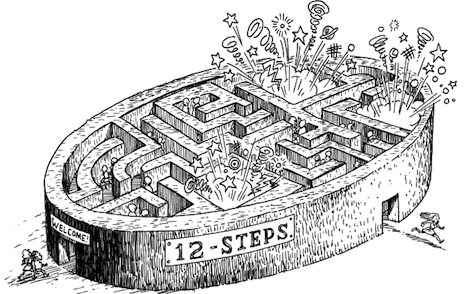
Leaving Alcoholics Anonymous, after 12 years, was one of the best things I have ever done. I didn’t leave consciously or with direct intent—not at first—but once I could look back on happy weeks and months without 12-step orthodoxy, I realized I would never go back.
The process began on January 1, 2000, when I began a residence at an arts colony in Vermont. I was 35 years old; I had grown up mostly in Manhattan and had been in AA since the age of 23. When I moved to Vermont on the first day of the millennium, with over 12 years of daily 12-step meeting attendance, I didn’t so much plan to stop going to meetings as never quite got around to looking for any.
Instead I got busy with the new people around me—all of them what 12-step people refer to as “civilians.” And what happened in those first interactions was a surprise. It took a while to notice, but I began to realize that nobody was getting angry with me, there were no sudden, out-of-the-blue explosions. People did not take offense over tiny or imagined slights. There were no attacks on my character; nobody derided me. All of a sudden I felt less of a need to be incredibly careful around other people. I had a sudden sense of freedom, a freedom from the long-term fear that I might unintentionally hurt someone’s tender feelings, or incite a terrible anger.
The fact that I had not been a heavy drinker didn’t bother anyone in AA, because “The only requirement for membership is the desire to stop drinking.”
This was most apparent with my new boyfriend, my first civilian romance in a dozen years. He did not become enraged that I didn’t notice his new haircut. Likewise, my newest close friend did not fly—unlike my past 12-step friend—into an unprovoked rage one summer’s day, ripping the picnic blanket out from under me in a crowded park and storming off screaming, “Get some help!” Instead, people were kind, low-key and friendly. I didn’t have to tread quite so gently.
As a 12-stepper, I had come into program after developing some pretty common symptoms of child sexual abuse. At 33, I had also been badly beaten on the street by a stranger. The result of trauma can be a hyper-vigilance and a guardedness. Someone once asked my housemate, “What is it with Louise?”—meaning why was I so edgy and easily rattled. My very sweet housemate, Kim, told the inquirer: “You know how some people are nice on the outside but not on the inside? Louise is the opposite.”
In the beginning, recovery was exhilarating; meetings left me elated. Before coming to meetings, I had struggled alone for years with abuse issues. In meetings I finally heard others who had also struggled. The difference between them and me was that they talked about their despair and substance abuse in the past tense. Now, they said, they had new, better lives full of gratitude. It was the first hope I had had in a long time. During my 12-step period, I always had a sponsor, I went through all 12 steps and I acknowledged a higher power. I also got off heavy medications and I went to more than a meeting a day. Over the years, I went to many kinds of meetings, including sexual abuse recovery groups and Alanon; I sometimes wonder whether that wasn’t the place I should have been all along, having grown up with addiction in my family.
Today, I question the way I was herded into AA as a 23-year-old. I had been in a hospital for an eating disorder and four months of life-threatening drug abuse with the man who had abused me as a child (yes, you read that right). I was immediately mandated to attend AA meetings on the hospital campus and off. I was told that getting sober—no drinking, no drugs, no “acting out” of any kind—was necessary for me to heal from my past.
It was largely a matter of timing: If it had been the ’70s, I would have been sent to EST; if it had been earlier in the ’80s (and if I’d happened to be immensely wealthy) it would have been daily Freudian therapy. But I was hospitalized in the late 1980s, when hospitals, rehabs and doctors began to channel people with all kinds of issues into “sobriety” and the basically free 12-step world. At one point before my supposed “bottom” I actually went to a therapist I found in the Yellow Pages. I told him I had an eating disorder and that evening, on his own time, he took me to an AA meeting, introducing me in a highly emotional tone to the group as someone he realized God had called on him to help. The fact that I had not been a heavy drinker never seemed to bother any doctor or social worker. It didn’t bother anyone in AA either, because “The only requirement for membership is the desire to stop drinking.”
Not everyone in program has been abused or suffered trauma—although many have. And addiction itself is its own trauma. No doubt there are many stable, well adjusted, and kind people in the 12-step movement. But I never met them, or if I did, I never got to know them.
Why didn’t I? That, I believe is why AA was dangerous for someone like me. Because I was not like “most people.” I was a victim of sexual abuse as a child, and as is very typical with people who have been abused as children, I had a self-defeating attraction to abusive people. Put me in a room with nine “well” people, and one “unwell” person, and I would likely—at that point it my recovery—have ended up talking to the unwell person. As AA is by definition full of addictive people, I was in a veritable candy land of danger, surrounded not only by addicts—but by sex addicts. What an array of addicts to choose from—partners I wish in retrospect that I had never even met. And even friends were were not always as they seemed.
One man I dated, and loved, eventually revealed he was married; then he came out as a sex addict and insisted I attend 12-step meetings for the partners of sex addicts—shifting the blame from himself as a betrayer to me as someone who “liked to go out with sex addicts.” Another man I was in a relationship with turned out to be in organized crime, confiding to me that he had once had someone’s legs broken. A very close friend in recovery stole someone’s identity and with it a great deal of money. Yet another friend, an artist, turned out to be funding his efforts with forgery. This is just a sampling of my romantic and social interactions among sober people in New York City in the ’90s. In my time outside of the recovery movement I have not met one civilian with this level of secrecy and deceit.
I proceeded with caution and asked two friends to be with me while I had my first drink in 18 years, just in case hell froze over.
Thomas Merton says that nothing is as difficult as human relationships. He calls them “the setting of broken bones.” So often did I feel attacked or taken aback by the reactions of people in program. More often, I felt that I was holding my breath, waiting for the axe to fall. One boyfriend called me “a selfish troll” for not noticing his haircut. Another threw me down his stoop on a New Year’s Day, after I suggested that his two screaming infant daughters—visiting him for the first time since his divorce—might be calmer if I was not there.
Recently, I recommenced an old friendship—the one that had ended with the blanket being pulled out from under me in the park. Everything went swimmingly until, sure enough, my old friend got viscerally, damningly angry at me. It had been so long since I had absorbed this dynamic—there was a familiar violence to her rage that I understood, but had not experienced in years.
In defense of AA I must say that I was told on my first day sober that it was “men with the men” and “women with the women.” My first home group, in Connecticut, was infamous for its rigor and actually sat men on one side of the room and women on the other. The second thing I heard was “no dating in the first year.” Did I follow this? Absolutely not. Did anyone I know follow this? In Connecticut, maybe, in uptown Manhattan, possibly—but in downtown Manhattan, where I spent the majority of my sobriety, absolutely not.
For the year before I moved to Vermont—my last year of attending meetings—I had a push-and-pull relationship with a fellow AA member. Towards the end of that year, he tried to commit to me and pursued me with a persuasive passion that I had never experienced. Finally, I relented, feeling hopeful, loved even. Immediately after this, I took a two-week trip to Vermont. When I returned, and called him, he seemed to be searching his memory, finally asking, vaguely, “So, where did we leave things?” A month later he was engaged to someone else.
Since then, I have never attended a meeting or dated a man in program. Not once have I uncovered a terrible lie or secret life. Instead, I got used to being around calm, consistent people and my tolerance and capacity for love increased by osmosis. To date I have been with my civilian husband for over seven years, my longest romance.
One day in 2006, with six years of recovery from “Recovery,” I made the conscious decision to try drinking again. I was more stable and happy than I had ever been: I was in a solid relationship with a decent, kind, honest man and I had a job. I had never been convinced that I was an alcoholic. I proceeded with caution and asked two friends to be with me while I had my first drink in 18 years, just in case hell froze over. We sat outside on a summer’s day by a small pool. It took about an hour before I felt willing to take that first sip of beer. My world did not end. I waited for the inevitable, but I did not immediately need another and another. Since then, after living in the outback of Western Australia for a year, I actually do rather like beer, and wine on occasion. For all my time in recovery, I always thought that if I drank again, I would run wild and go to raves and taste all the new fancy drinks that had come out. But I never have.
In AA meetings, older members will often say they are now sober for as long as they drank, and the catchphrase is, “I am out of the woods.” Having been in program for 12 years—and now out for 12 years—I can say precisely the same thing. I am out of the woods and the world has never been clearer or happier for me. Perhaps the program had worked its magic on me: “We will love you until you can learn to love yourself,” they say. But by the time I learned what love was, I was out the door.
Louise Wareham Leonard is a journalist, editor and the author of two novels, Since You Ask and Miss Me A Lot Of. She has also been published in Gargoyle, Poetry and HotelAmerika and is a reader for Tin House.