
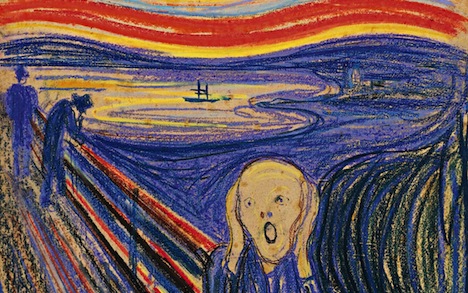
Until I got sober, I’d never had a panic attack. But after I quit drinking, out of nowhere I started getting floored by them. I had no idea what was happening. I’d be on the subway and suddenly have an existential crisis: What was I doing with my life? Why wasn’t I there when my dad died? Why did I sleep with all those randos? Those obsessive, pounding thoughts were always accompanied by shortness of breath and hysterical crying.
Eventually I picked up some tools and the panic attacks went away. But now, five years later, with things starting to go well in my artistic career, the panic attacks are back. I can hold it together while I’m performing but afterward I’ll burst out in tears and start hyperventilating. What the fuck?
Half the time when I’m feeling panicky, I’m just hungry and need to eat a banana.
Luckily for me, my symptoms are pretty mild. For others, panic attacks can include heart palpitations, hot flashes and nausea. According to Dr. Petros Levounis, director of the Addiction Institute of New York, “People who suffer from severe panic attacks walk down the street sweating, with heart palpitations, an overwhelming sense of doom and a preoccupation that they’re going to die.”
If things are that bad, you should definitely talk to your doctor. But for less severe symptoms, try out a few of the following at-home remedies—recommended and tested by me, my friends and other experts—to get some relief and help keep you on an even keel.
HALT AKA “Hungry, Angry, Lonely, Tired.” Check in with yourself and see whether you’re feeling any or all of these things. Half the time when I’m feeling panicky, I’m just hungry and need to eat a banana. Angry? Call your sponsor to vent or work out to burn off the hate. Lonely? Get together with a friend for a coffee (but not more than one cup—see below). Tired? Go to sleep already!
Yoga Yoga has consistently helped me the most in this department—so much so that I eventually became a yoga teacher. I believe that feelings build up in different parts of our bodies, especially our hips, and yoga can help you experience them in a way you might not normally be able to. Lately I’ve been into aerial yoga, which uses a hammock to combine yoga and dance moves. I can’t think of anything more relaxing than laying in a little baby cocoon for 15 minutes.
Cardio Running fast while listening to hip-hop very loudly will drown out those anxious and panicky thoughts. Also, the endorphins help you feel less bummed. I recommend Nicki Minaj or Lil’ Wayne.
Meditation AA’s 11th Step is, “Sought through prayer and meditation to improve our conscious contact with God as we understood Him, praying only for knowledge of His will for us and the power to carry that out.” This is the meditation step, and it can take many forms. The one I find the most accessible is simply sitting and breathing. Close your eyes, inhale, and exhale. On the inhale, say, “Faith”; on the exhale, say “Fear,” and watch your fear float away as it’s replaced by faith. You can also try counting to 10 on your inhales and exhales, and go back to one when you have a thought. (I usually don’t make it past three.) If you’re new to meditation, there’s an iPhone app called Meditate Now, with several quick, guided meditations.
Talk it out If you’re freaking out, it’s good to get it out. For AA members, your sponsor—or, for people in recovery outside of a 12-step program, a friend or family member—is a huge part of your support network. But they might not be able to help you with the underlying issues causing your anxiety, like a therapist can. A great resource for sliding-scale therapy in New York, for example is Washington Square Institute. Brooklynite Tom says, “Full-blown anxiety/panic attacks didn’t start for me until year four in sobriety, and years four through six saw them ramp up to the point where I was having them every day. Talk therapy coupled with a yoga and meditation practice are now enough to curtail any anxiety I have, for the most part. I meditate in the morning and I’m happy to say I rarely have full-blown anxiety attacks any longer.”
Prayer I’m always shocked when prayer works—when I have the willingness to pray about something and then it gets removed from me. One thing that helps when I’m losing it is the Golden Key, which basically says that if you’re obsessing about your struggle, just think about God instead. Sounds infuriatingly simple, but it works. Find a prayer—or mantra or chant or whatever—that you like and, when you’re in a tight spot, keep repeating it until you calm down.
Caffeine intake If you’re like me, you’re a sober vegetarian who doesn’t smoke. Coffee is all you have left! When anyone tries to talk to me about my caffeine addiction, I’m like, “Back off!” But the truth is, coffee will mess with you. It’s a stimulant, which can increase your heart rate and intensify (and even trigger) panic attacks. New Yorker Heidi says, “I stay away from caffeine stronger than tea and I try to get enough sleep because when I’m very tired and overcaffeinated I tend to freak out way more easily.”
When I was newly sober, my panic attacks were so severe that I used Xanax for six months.
Acupuncture It may sound weird to have someone poke tiny little needles into your body, but Samantha Story, MS, LAc, says that acupuncture can help alleviate anxiety. According to Eastern medicine, panic attacks can result from a miscommunication between organs in your body. “Fear energy lives in the kidneys and can rush up and overwhelm the heart, which always wants to be in charge,” Story tells me. “Acupuncture can make sure everything in your body’s communicating effectively.” Every patient is different, and it can take three or four treatments to see changes—so don’t give up. After 9/11, the now-demolished St. Vincent’s Hospital in Manhattan ran an acupuncture program, and its success in in helping victims feel calmer prompted the American Red Cross to add ear acupuncture to its 9/11 Mental Health and Substance Abuse Program reimbursable services list.
Essential oils Story also recommends smelling essential oils as an instant mood-changer. “Changing your sensory outlets changes your perspective,” she says. Certain scents affect people differently, but Story recommends lavender for calming, citrus for depression and rose oil for calming the heart.
Passionflower An herb (no, not that kind) that you can drink. Mix it with water, obviously, because it tastes like dirt. I’m really into it right now, and use it before going onstage to quell that panicky feeling. For me, two dropperfuls makes me fall asleep, but one is just right. Make sure to buy the alcohol-free version!
But what about pills? What happens when you have several years clean but you’re still having panic attacks? Marin of Minneapolis says, “I was sober for six years and I thought if I just worked the steps hard enough, slept enough and went to enough therapy, I’d be fine. I wasn’t.” There are many types of pills that help with anxiety—but I’m not a doctor, and you should always speak with your doctor if you’re considering this option.
Benzos For sober people, there are good meds and bad. Benzodiazepines like Xanax, Klonopin, Valium and Ativan are extremely addictive and not the best option for people in recovery. According to Dr. Levounis, these drugs are “quite addictive and have gotten a lot of people in trouble.” He adds: “They activate the same neurotransmitter receptors in the brain as alcohol. Exposing yourself to them can lead to relapse.”
When I was newly sober, my panic attacks were so severe that I used Xanax for six months. I’d never been a pill-popper, so when my doctor suggested I try it, I didn’t see any problem. I took only half a pill when I felt my chest getting tight and my thoughts spinning out of control. It was great. But then—oops—I started to crave it. I had the twisted alcoholic thinking that, “If I give myself a panic attack, then I can have a Xanax.” No good. Just because I’d never had a pill problem didn’t mean it was too late to get one. So I put the ixnay on the Xanax ASAP.
SSRIs (antidepressants) Unlike benzos, SSRIs “do not have an addictive potential,” according to Dr. Levounis—although, as with any medication, they should still be monitored by a doctor. (You can also experience some wicked withdrawal symptoms when you stop taking them, so be aware.) Specific antidepressants that have been recommended by sober people who’ve suffered from panic and anxiety include Lexapro and Celexa. Marin says, “Before I started taking Celexa, I felt like there was a hamster wheel in my brain. I had panic attacks once a month. Now I’ve only had two in the last two years. I don’t feel numb but it allows me to stay more in the moment and not spin out. My anxiety doesn’t take hold of me anymore.”
If all else fails, try Laughing Yoga. Or even just chilling out—literally. When New Yorker Kelly starts feeling panicky, she says, “I lay on the cool bathroom floor to rectify my skyrocketing body temperature. Then I attempt to walk it off.”
Sarah Jones is a pseudonym.